Tuesday, December 11, 2012

Human Variation & Race Blog


1. I chose (a) heat.  Heat can make everything more challenging. For example, if person needs to work outdoors. If it is extremely hot outside, the person may find themselves sweating more, aggravated because of heat irritation and increasingly difficult to concentrate on the work they want to perfrom.
2. Sweating for short term
Facultative adaptation would be the skin tone. The pigments in a person’s skin plays a role in reflecting or absorbing sun light.


Developmental adaptations would be our cranial capacity. With humans advancing in technology thanks to our complex and evolving brains, we have invented air condition to keep us cool.


Cultural adaptations include Arabic people wearing turbans to stay cool.
 
3. We can compare how different races deal with similar problems. For example how to Arab and Chinese people cope with heat.
4.  It is difficult to use race to understand variation of adaptations. Since most races are very similar genetically. Rather studying environmental influences is a better way to understand human variation because we can identify the reaction to a stress. For our heat example, it would be during high heat, human population have learned to stay hydrated, use protective clothing and avoid or reduce activity during high heat hours.

Tuesday, December 4, 2012

Language Blog

Part 1.

I underestimated the difficulty of this task.  When I first stared this assignment, I thought because my partner and I had know each other so well, it would be easy to conduct this assignment. However, when I wanted to get my point across without being able to speak proved very difficult.  I was using signs, body language and my partner was speaking to me. We established a system of elimination, where i would have a signal for yes that was raising right hand and no by raising the left.
At first my partner found the task humorous and was having a lot of fun not achieving anything. Then gradually he became more sync with me. His method of communication with me remained verbal.
If my partner and I represented two different cultures meeting for the first time, the culture which could converse verbally definitely would have the advantage of communicating complex ideas. The attitude of speaking culture would be feeling superior to the culture that did not use symbolic language.
2. Speaking for 15 minutes without any "feel" to it made me sound like a robot. It felt like I wasn't real and the conversation didn't sound normal. I could not speak this way for the entire 15 minutes.  My partner disconnected periodically. At times he didnt understand the true meaning or the intentions of my speech because my tone was lacking any kind of emotion. I would say the importance of non-speech language techniques are just as important as speaking verbally. They add emotion and make it more interesting, our body language tells what kind of attitude we might be having at the moment and gives the audience a sense of our personality. Presumably there might be some people who have a harder time reading body language than others, the reasons could very from being mentally challenged or not being able to see clearly.

Tuesday, November 20, 2012

Piltdown Hoax


The Piltdown hoax was an Archaeological site in England, which was discovered in 1908 by Charles Dawson. The scientific community was shocked at the findings as this was a crucial period for evolution. At the site, a fragment of what appeared to be an ancient human skull was found along with animal fossils.  Perhaps most astonishing find was a jawbone, apparently to the same skull found earlier. The jawbone was surprise because it did not look human, it actually looked more like it belonged to an ape. This remarkable find appeared to fit as the last piece to human evolution puzzle, the “Missing Link”.
The hoax was discovered after Word war two. A new technology, chlorine testing allowed scientist to measure roughly date fossils. When they tested the Piltdown fossils,  the results returned was the fossils were relatively young. It would of made sense, if the remains were millions of years old, however they turned out to be more like hundred thousand. Another evidence on how the findings were a hoax was the fact that the teeth were filed down, the were scratch marks, as if some-one purposely wanted to shape these to a desired shape. Finally the jawbone was tested as well and even more surprisingly it dated back only to less than one hundred years.
Charles Dawson died before the hoax was discovered.  Father Tielhard who was an original member of the findings, was very quiet when the hoax was unraveled.  There were other scientists prior to announcement of the hoax,  who were coming up with mixed results after re-examining the bones. For example in 1913 David Waterson stated that  the skull was of a human and the jaw belonged to an ape. A german anthropologist by the name of Franz Weidenbreich who studied evolution studied the remains and he came to similar conclusion that the skull was perhaps of a fossilized ape and that the jaw appeared to be of an orangutan with filed down teeth.

Scientists are indeed humans, and all humans make mistakes. The faults the come into play for this scenario was simply lack of knowledge. Without the tools and technology they could not have tested the age more accurately. This negatively impacted the scientific process because at the time it formed a falsiable hypothesis which couldn’t be tested wrong. Those who were skeptic, kept silent and choose not to speak out against such prominent figures of the time such as  W.J.  Sollas.
In 1953, Scientists launched full scale analysis of the remains. It included radiological dating methods. Pieces were broken off which could of shown that the jawbone did not belong to the skull. They also removed the pieces that would of shown that the bones did not match directly. Furthermore, evidence showed that the front part of the jaw was broken off which proved to be of an ape and not human like specie.

I think it is possible to remove the “human” factor from science at least to a certain extent. A good example of this would be computers. Large, complex calculation no longer have to be handworked and result in human miscalculation, instead computers accurately calculate a desired data for us. I would like to remove the human factor as much as possible to prevent such incident as the Piltdown hoax from wasting the scientific community’s time.
The moral of the story for me was to be very skeptical when approaching new discoveries from an unverified source.  One can be duped purposely to believe something that is not true and waste precious time. Most importantly, I would limit myself from jumping to conclusions no matter how good the outlook my project to be.

Wednesday, November 14, 2012

Comparative Primate Blog Post

A) A thorough description of the environment in which the primates lives.


Lemurs are native to Madagascar. They spend most of their time in the trees.  There are different breeds of lemurs such as ring tailed lemurs (pictured), brown lemurs and sifakas. Majority of lemurs are diurnal which means they are awake during the day and asleep during night. Lemurs diet consist of plants and insects.


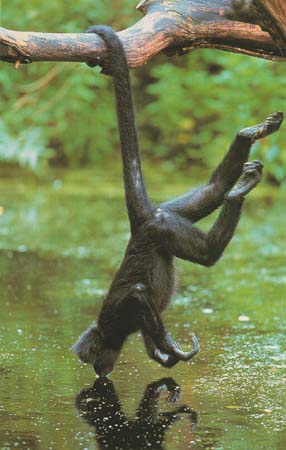
Spider monkeys are new world monkeys who are typically found in tropical forest of Central and South America.  They live high up in the canope so they can find food (fruits , plants and seeds) easily.
Baboons are extremely adaptatious primates that can be found in various settings. For example Saudi Arabia and Africa.  Like most primates an essential part of their survival is source of water and a safe place to sleep.
Gibbons are extremely arboreal.  They are primarily found in tropical forest of Asia such places as China, India and Indionesia.
Chimpanzees natural habitat is African rain forest. They can be very adaptive as well and can also be found in wetlands, bamboo forests and swam forests. Chimps spend a lot of time in the trees.

B) A description of your specified character trait for that primate. (Sociality and Mating patterns)
Lemurs live a group setting, composed of males and females. In the group there is usually a dominant female who leads them  to food sources. Males in the group normally leave when they mature.  In a social group blood relatives stay close together and groom each other. They can become hostile towards strangers. Adult females are also more dominant than males and show it by biting, chasing and grabbing their male partners.

Spider monkeys are very alert. During the day they break up into smaller groups to gather food . Males tend to stick with each other for lifetime. A group of spider monkeys is led by a female who plans for days food course. Because they lack thumbs, grooming Is not common. Females attract males by their unusual long labia which most often is mistaken for penis.
Mating
Spider Monkeys mate year round. Females choose a male from the group to mate with. Both sexes sniff each other to check readiness to breed. For the first 4 months after a baby is born, it cling to its mothers belly. Males are completely free from parental obligation.
Baboon females are generally close to their mothers, sisters and aunts. They groom, rest and sleep by each other’s side.  They don’t behave similarly with non relatives. For most females they inherit dominance from their mother.  Males dominance on the other hand is entirely based on size and aggression. The bigger in terms of size the males are the more dominant and higher ranking they become.
Mating
High ranking males produce more offspring than low ranking males. They achieve this by spending more time close to female partner, grooming her and frequent copulation.
Gibbons
Sociality
Gibbons live as a family which usually consist of a male, female and a younger offspring. A family is territorial and the couple sing songs in the mornings. There is a balance of power between adult males and females who live together.
Mating
When an offspring nears maturity, the parents evict it to prevent from inbreeding. The mature offspring then embarks on a journey to find a partner, if successful then the couple seek to settle in a territory and defend it.
Chimpanzee
Sociality
Chimps cohabit in communities which vary in size At times the community has gatherings which is considered a social event because the members play, breed and groom. Generally there is adult male who is considered a leader of the community.
Mating
Because chimps live in a mixed gender community the females breed with many males. The males normally treat all offspring as their own. Chimps are considered adults by age 15. The gestation period is usually around 9 months, exactly like humans. This is because chimps are our closest relatives having in common over 98% of our DNA.
C) A discussion on how the primate’s trait expression has been influenced by its environment, i.e., how can the trait be viewed as an adaptation to the primate’s environment.
Lemurs
Compare to other primates lemurs have a longer snout which increases their ability to smell. However unlike other primates they have a smaller brain.  This explains why the dominant female, that has greater sensibility than rest of her group is first to choose a mating partner.
Spider Monkeys
They use their tails to aide them climb trees. They hunt in groups which explains they’re social and matting patterns.
Baboons
Excellent at adapting to various environments such as rainforests and coastal areas. This allows the males to mate with females regardless of what territory or conditions they are in. Without having to worry about food, because Baboons are not picky eat eaters, males can attract females by grooming and spending time with them.
Gibbons
Thanks to their long arms and ability to hook their hands over branches to help them swing from one branch to another. It is in the same environment (treetops) that Gibbons generally mate. Because Gibbons tend to stick around with same partner it understandable why parents evict their sub-adult offspring from their territory to decrease chances of inbreeding.
Chimpanzee

The fact that Chimps tend to live in communities might explain how they're social and mating pattern. Chimps follow a social order from their hierarchy thats influenced largely by females in that subgroup. The males guard their territory and females mate with multiple males.

Summary
Summarize your findings, evaluating the level of influence the environment has on the expression of physical and behavioral traits.

The environment plays a crucial role on physical and behavioral traits of these primates. For example most of these primates if not all are considered endangered species due to humans hunting them, altering or destroying their living habitat. Take Spider Monkeys for example, where the males tend to stick with each other most of their life and hence are likely to be close relatives. With an increase in humans hunting them and destroying their habitat, it will be extremely difficult for the monkeys to find food, shelter and partners. More importantly their endangerment also influences their mating patterns as they are know to break up into smaller groups during the day and the females disembark or abandon their families to join other groups. Therefore altering a natural environment places a stress on these primates to adapt in order to be successful at life's essential ingredients and produce offspring that carries a more dominant trait for adapting into more challenging environments.


Friday, November 9, 2012

Analogy/Homology Blog Post


1) A. Two different species that possess the homologus trait are butterflies and dragonflies.
B) Dragonflies and butterflies possess two pair of wings.  The butterfly's wings are made up of two large pairs of wings eachpossessing a forewing and a hindwing.  The veins in the wings nourish them with blood.  Butterflies can’t fly if the temperature of their body falls below 85 degrees and therefore need to sun themselves in order to warm up.  Some butterflies can fly up to 30 miles per hour. 

Dragonflies have two pairs of wings that are transparent, rigid, straight, and have few veins.  They do not fold or bend.  Unlike butterflies, dragonflies are experts at flying.  They can reach speeds up to 90 miles per hour! They can fly sideways, backwards, hover, turn at right angles and of course fly straight
C) The ancestors of modern dragonflies are called Protodonata which were among the 1st winged insects on Earth. The reason we know their ancestor possessed this trait is thanks to fossil records.

D)


2) A. An of example of analogous traits would be the fins of whales and the fins of fish.
B. Both whales and fins each possess at least 1 fin. The primary function of their fins is to guide them during their swim.
Fins located in different places on the fish serve different purposes, such as moving forward, turning, and keeping an upright position.
c. The common ancestor of these two species did not possess this analogous trait. The reason being Whales developed their fins independently.


D.

Thursday, October 25, 2012

Thomas Malthus

1. I picked Thomas Malthus that I believe had most influence over Darwin's development of his theory of Natural Selection.

2.Thomas Malthus contributed to the scientific community by composing an essay titled "Principle of Population". In it, Malthus described through his observation of nature plants and animals, that they produce way more offspring than can survive. He went further by comparing and arguing that man, too, is able to overproduce if there is no regulation. This will result in misery as human population grows uncontrollably, it will simultaneously see a rise in poverty and famine. Eventually it will reach a point where there will be chaos on earth and mankind will diminish as a result.
source: http://www.ucmp.berkeley.edu/history/malthus.html

This also relates to our textbook how Thomas Malthus compared his study of plants and animals to humans.
"Physical Anthropologist, for example, are interested in how humans both differ from and are similar to other animals, especially nonhuman primates" Chapter 1 Page 24, Paragraph 2.

3.The points most directly affected by this individual’s work are:
Resources are limited. Our planet has a limit of much it can hold and produce. There will not be
enough resources available for all organisms to reproduce as many offspring as they can.

This helped Darwin recognize that our natural resources are limited and cannot fulfill the demand of overpopulation.

I also believe that this influenced Darwin to recognize another point
Who gets better access to these limited resources?
As the resources run low, the level of competition increase among population. Those who are better adapted to their environment would have greater reproductive success because their traits allowed to be more competitive and get the essential resources for reproduction purposes.

4. I dont think Darwin could have developed his theory of natural selection without the influence of Thomas Malthus' Principle of Population. It was merely this masterpiece that helped Darwin recognize that challenges of over-production. Nevertheless, Darwin built upon this very theory to undermine Malthus by further explaining that over-production actually increases competition among siblings, and that some variation among siblings would produce some people with slightly higher chance of survival. 

5. Charles Darwin maintained a continuous relationship with the church throughout his lifetime. At one point in time he had plans to become a clergyman in the Church of England, but later abandoned that goal. At the time there was intense conflict over religious morality in England. The Evangelicalism led to surge in professionalism of clerics who were seriously focused on expanded religious obligations. They too stressed that the Bible should be read literally and that religious doubt was in itself sinful so should not be discussed. 

For Darwin this was an opportunity to counter church's strict close mindness. For example, as the scientific community was providing more research material supporting evolution, the church at first condemned the publications, later countered it by saying its "God's tool".

For Darwin,  this was time to advocate his work with the goal of winning the church's support. His approach was not blasphemous, but rather advocacy to explain evolution through logic and explanation, not denial of God's role (higher power) which is mentioned in his publication.