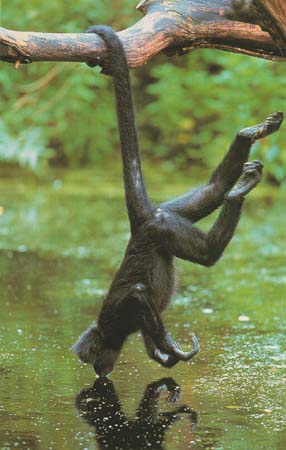
Spider monkeys
are new world monkeys who are typically found in tropical forest of Central and
South America. They live high up in the
canope so they can find food (fruits , plants and seeds) easily.
Baboons are
extremely adaptatious primates that can be found in various settings. For
example Saudi Arabia and Africa. Like
most primates an essential part of their survival is source of water and a safe
place to sleep.
Gibbons are
extremely arboreal. They are primarily
found in tropical forest of Asia such places as China, India and Indionesia.
Chimpanzees
natural habitat is African rain forest. They can be very adaptive as well and
can also be found in wetlands, bamboo forests and swam forests. Chimps spend a
lot of time in the trees.
B) A description of your specified character trait for that primate. (Sociality and Mating patterns)
Lemurs
live a group setting, composed of males and females. In the group there is
usually a dominant female who leads them
to food sources. Males in the group normally leave when they
mature. In a social group blood
relatives stay close together and groom each other. They can become hostile
towards strangers. Adult females are also more dominant than males and show it
by biting, chasing and grabbing their male partners.
Spider
monkeys are very alert. During the day they break up into smaller
groups to gather food . Males tend to stick with each other for lifetime. A
group of spider monkeys is led by a female who plans for days food course.
Because they lack thumbs, grooming Is not common. Females attract males by
their unusual long labia which most often is mistaken for penis.
Mating
Spider Monkeys mate year round. Females choose a male
from the group to mate with. Both sexes sniff each other to check readiness to
breed. For the first 4 months after a baby is born, it cling to its mothers
belly. Males are completely free from parental obligation.
Baboon females are
generally close to their mothers, sisters and aunts. They groom, rest and sleep
by each other’s side. They don’t behave
similarly with non relatives. For most females they inherit dominance from
their mother. Males dominance on the other hand is entirely based on size
and aggression. The bigger in terms of size the males are the more
dominant and higher ranking they become.
Mating
High ranking males produce more offspring than low
ranking males. They achieve this by spending more time close to female partner,
grooming her and frequent copulation.
Gibbons
Sociality
Gibbons live as a family which usually consist
of a male, female and a younger offspring. A family is territorial and the
couple sing songs in the mornings. There is a balance of power between adult
males and females who live together.
Mating
When an offspring nears maturity, the parents
evict it to prevent from inbreeding. The mature offspring then embarks on a
journey to find a partner, if successful then the couple seek to settle in a
territory and defend it.
Chimpanzee
Sociality
Chimps cohabit in communities which vary in
size At times the community has gatherings which is considered a social event
because the members play, breed and groom. Generally there is adult male who is
considered a leader of the community.
Mating
Because chimps live in a mixed gender
community the females breed with many males. The males normally treat all
offspring as their own. Chimps are considered adults by age 15. The gestation
period is usually around 9 months, exactly like humans. This is because chimps
are our closest relatives having in common over 98% of our DNA.
C) A discussion on how the primate’s trait expression has
been influenced by its environment, i.e., how can the trait be viewed as an
adaptation to the primate’s environment.
Lemurs
Compare to other primates lemurs have a longer snout
which increases their ability to smell. However unlike other primates they have
a smaller brain. This explains why the
dominant female, that has greater sensibility than rest of her group is first
to choose a mating partner.
Spider
Monkeys
They use their tails to aide them climb trees. They hunt
in groups which explains they’re social and matting patterns.
Baboons
Excellent at adapting to various environments such as
rainforests and coastal areas. This allows the males to mate with females
regardless of what territory or conditions they are in. Without having to worry
about food, because Baboons are not picky eat eaters, males can attract females
by grooming and spending time with them.
Gibbons
Thanks to their long arms and ability to hook their hands
over branches to help them swing from one branch to another. It is in the same
environment (treetops) that Gibbons generally mate. Because Gibbons tend to
stick around with same partner it understandable why parents evict their
sub-adult offspring from their territory to decrease chances of inbreeding.
Chimpanzee
The fact that Chimps tend to live in communities might
explain how they're social and mating pattern. Chimps follow a social order
from their hierarchy thats influenced largely by females in that subgroup. The
males guard their territory and females mate with multiple males.
Summary
Summarize your findings, evaluating the level of
influence the environment has on the expression of physical and behavioral
traits.
The environment plays a crucial role on physical and
behavioral traits of these primates. For example most of these primates if not
all are considered endangered species due to humans hunting them, altering or
destroying their living habitat. Take Spider Monkeys for example, where the
males tend to stick with each other most of their life and hence are likely to
be close relatives. With an increase in humans hunting them and destroying
their habitat, it will be extremely difficult for the monkeys to find food,
shelter and partners. More importantly their endangerment also influences their
mating patterns as they are know to break up into smaller groups during the day
and the females disembark or abandon their families to join other groups.
Therefore altering a natural environment places a stress on these primates to
adapt in order to be successful at life's essential ingredients and produce
offspring that carries a more dominant trait for adapting into more challenging
environments.

Ahmad,
ReplyDeleteI will be emailing you regarding this post.
Better. Thank you. If you posted comments, email me the blogs where I can locate them.
ReplyDelete